EIQ Analysis Summary
I. Purpose of EIQ Analysis
EIQ analysis is a methodology to analyze vast shipping data and derive distribution center system plans and optimal logistics equipment selection from the results.
II. Turning Data into "Live Information"
To succeed in analysis, a step is required to convert raw transaction data into information useful for practical operations.
- Sampling: Grasp overall trends (patterns) with data from a representative day or week, and understand maximum loads with separate peak-period data.
- Unit Standardization (Normalization): Unify data where pieces, cases, and pallets are mixed using conversion factors to visualize the true site workload.
- Stratification: Group by characteristics (weight, temperature zone) or ABC rank to perform high-precision layout planning.
III. Definition of EIQ
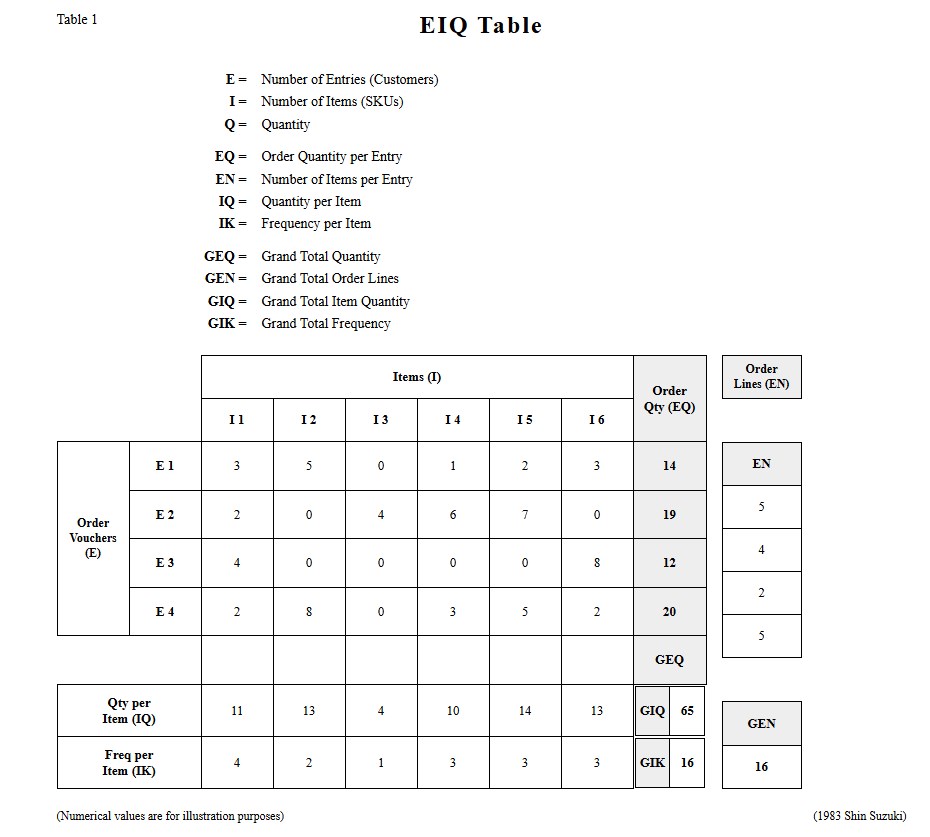
1. E (Entry: Number of Order Entries)
The number of "destinations" for orders. Different shipping locations are counted as separate Entries to correctly understand delivery routes and unloading loads.
2. I (Item: Number of SKUs)
The minimum unit of inventory management (SKU). Physically distinct items are counted as one Item, deriving the number of times shelves are accessed during picking.
3. Q (Quantity: Amount)
The total volume of work. If shapes differ significantly, items are grouped to prevent selection errors in storage equipment.
| Customer(E) \ Item(I) |
I1 |
I2 |
I3 |
I4 |
I5 |
I6 |
EN (Items) |
EQ (Qty) |
| E1 |
3 |
5 |
1 |
2 |
3 |
- |
5 |
14 |
| E2 |
2 |
- |
4 |
6 |
7 |
- |
4 |
19 |
IV. Analysis of Order Characteristics
Order Size
Refers to the content of each order (Quantity EQ and Item Count EN). Understanding the scale per order helps determine packaging forms and picking methods.
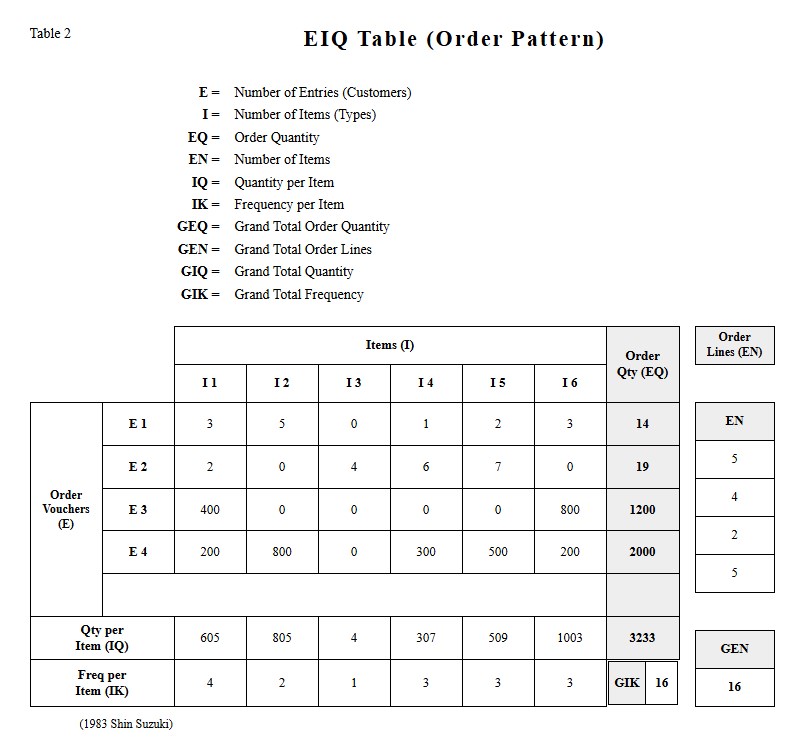
Order Pattern
The distribution state of order sizes across the entire center. This determines whether **Single Picking** or **Batch Picking** is more efficient.
V. 9 Key Factors
| Category | Index | Content |
|---|
| Basic Elements | E / I / Q | Orders / Items / Quantity |
| Order Characteristics | EQ / EN | Qty per order / Items per order |
| Shipping Characteristics | IQ / IK | Qty per item / Shipping frequency per item |
| Overall Trend | Size / Pattern | Order scale / Distribution state of the entire table |
VI. Integration of Analysis Methods
EIQ analysis combines the following methods to highlight logistics reality:
- ABC Analysis: Ranking by importance.
- Frequency Analysis: Understanding data variance and volume zones.
- PCB Analysis: Correlation analysis by packaging form (Pallet, Case, Bulk/Piece).